
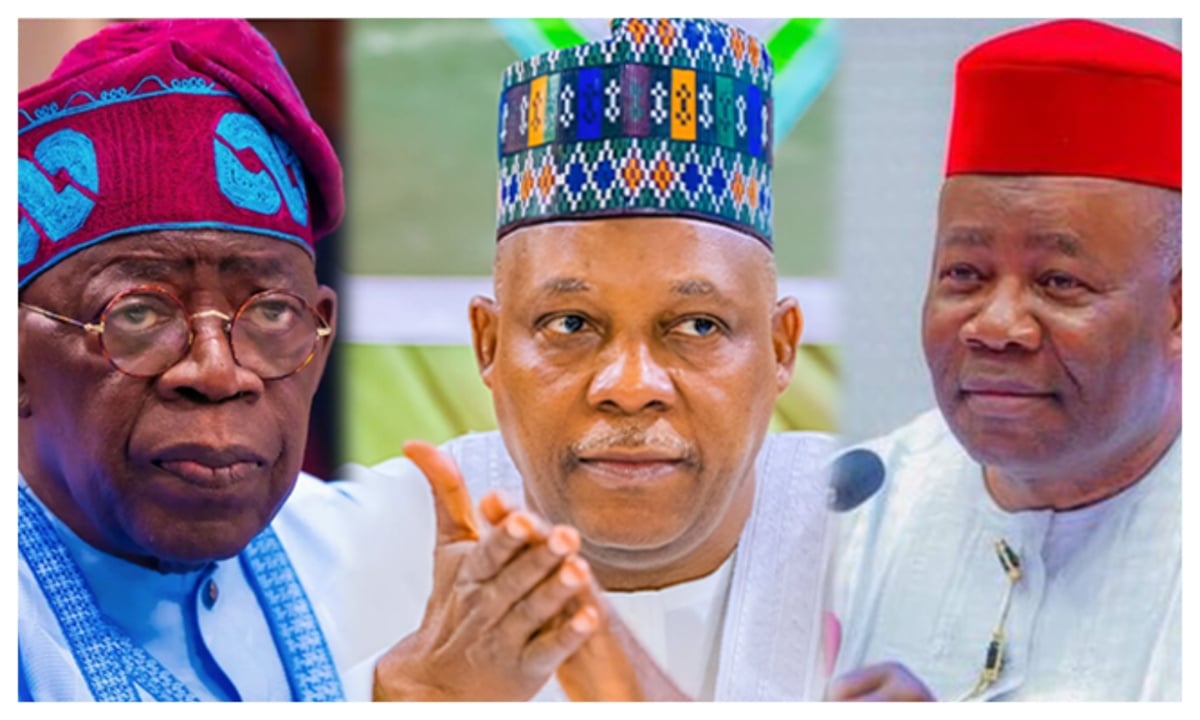
The simultaneous absence of President Bola Ahmed Tinubu, VicePresident Kashim Shettima and President of the Senate, Senator Godswill Akpabio, from Nigeria has triggered a fresh constitutional controversy among lawyers over presidential authority, succession and the continuity of government.
President Tinubu had travelled out of Nigeria on August 30 for what the Presidency described as a threeweek working vacation in Europe. Vice-President Shettima subsequently travelled to the United States to lead Nigeria’s delegation to the 81st United Nations General Assembly(UNGA), while Senate President Akpabio was also reported to be outside the country until few days ago. He was in Italy.
This development, however, generated questions about whether the 1999 Constitution, as amended, permits the President, Vice-President and Senate President to be outside Nigeria simultaneously and more importantly, whether such simultaneous absence creates a constitutional vacuum. The controversy has prompted different legal interpretations.
While some lawyers submitted that the physical absence of the President and Vice-President did not automatically transfer presidential authority to the Senate President, others argued that the Constitution requires a clear mechanism for the exercise of presidential powers whenever the President was away on vacation or otherwise unable to perform his functions.
Tinubu’s Extended Stay
President Tinubu departed Nigeria on August 30, 2026, beginning a three-week working vacation in Europe. The Presidency subsequently announced that he had extended his stay by a few days and was expected to return to Nigeria at the weekend.
Vice-President Shettima left Nigeria on September 20 for New York to represent Nigeria at the United Nations General Assembly. The Presidency said he was carrying the President’s mandate at the international gathering.
The simultaneous absence of the two principal occupants of the executive branch has raised questions about Section 145 of the Constitution, particularly because the provision deals specifically with situations in which the President proceeds on vacation or is otherwise unable to discharge the functions of his office.
The Presidency has maintained that President Tinubu remained in contact with officials in Nigeria and continued directing the affairs of government while abroad.
It also said Secretary to the Government of the Federation, George Akume, would continue to represent the President at official functions while Shettima was outside the country.
But critics have questioned whether continuing to communicate with officials from abroad was sufficient to satisfy the constitutional requirements governing presidential absence.
What Did Section 145 Say?
The starting point of the constitutional debate is Section 145 of the 1999 Constitution. Section 145(1) provides that whenever the President is proceeding on vacation or is otherwise unable to discharge the functions of his office, he shall transmit a written declaration to the President of the Senate and the Speaker of the House of Representatives.
The provision states that, until the President transmits a declaration to the contrary, the Vice-President shall perform the functions of President as Acting President.
Section 145(2) further provides that if the President is unable or fails to transmit the written declaration within 21 days, the National Assembly may, by a simple majority vote in each chamber, mandate the Vice-President to perform the functions of President as Acting President.

The wording of the provision has consequently become central to the current dispute.
One interpretation is that the President has a constitutional obligation to transmit the written declaration immediately whenever he proceeds on vacation.
Another interpretation is that the 21-day provision provides a constitutional mechanism for dealing with a President, who has failed to transmit the declaration within that period.
However, a lawyer and public affairs analyst, Victor Ekweze, noted that the use of the word “shall” in Section 145(1) makes transmission of the declaration mandatory when the President proceeds on vacation.
Another school of thought however submitted that the constitutional arrangement contemplated a period of up to 21 days before the National Assembly would need to intervene.
Does Physical Absence Mean Loss Of Presidential Power?
Another important question is whether the Constitution expressly requires the President to remain physically within Nigeria in order to exercise presidential powers.
The Constitution did not state that the President automatically ceases to exercise his constitutional functions merely because he leaves Nigeria.
A recent analysis of the issue noted that Section 145 focuses on whether the President is on vacation or is otherwise unable to discharge the functions of his office, rather than simply whether he is physically within Nigerian territory.
This distinction is significant. A President may be physically outside Nigeria and still maintain contact with government officials and exercise executive responsibilities.
However, Section 145 creates a specific constitutional procedure for situations in which the President is proceeding on vacation or otherwise unable to discharge his functions.
The question, therefore, is not simply whether President Tinubu is in France, Britain or Nigeria. The more precise constitutional question is whether the circumstances of his absence activate Section 145 and whether the procedure prescribed by that section has been followed.
What About Senate President Akpabio?
The presence of Senate President, Godswill Akpabio, in the discussion has generated another constitutional misconception: whether his absence from Nigeria prevents him from being part of the constitutional succession arrangement. Section 146 is important here.
The Constitution provides that where the office of President becomes vacant by reason of death, resignation, impeachment, permanent incapacity or removal, the VicePresident becomes President.
Section 146(2) provides that where the offices of both President and Vice-President become vacant, the President of the Senate shall hold the office of President for a period not exceeding three months, during which an election shall be held.
A lawyer, Dejo Akinde, while analyzing this said that,” Section 146 concerns vacancy in the offices, rather than the mere fact that the President and Vice-President are temporarily outside Nigeria.
“This means that the Senate President does not automatically become Acting President simply because the President and Vice-President are travelling abroad.
“The present circumstances therefore do not, on their face, place Akpabio in the presidential office under Section 146”.
The constitutional debate instead centres on whether the President has complied with Section 145 and whether, in the absence of the Vice-President, there is an adequate constitutional mechanism for the performance of presidential functions.
Credit: New Telegraph