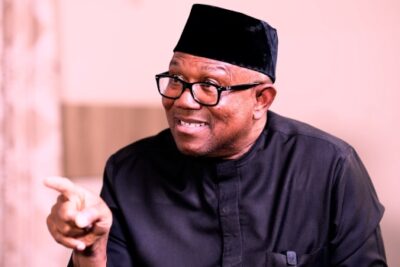

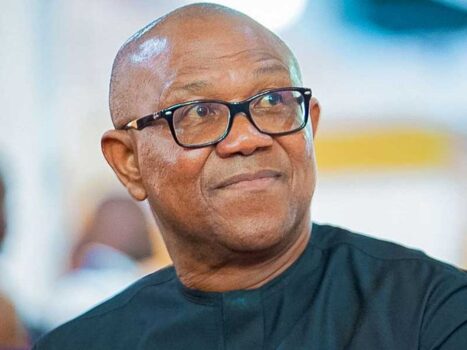
The Nigeria Democratic Congress (NDC) presidential candidate and former Anambra State governor, Peter Obi, has charged editors and the Nigerian media to guide politicians towards issue-based campaigns ahead of the 2027 general elections.
Obi, who spoke while addressing editors at the 22nd All Nigeria Editors Conference in Enugu State, however, began by making it clear that he was not invited to the conference but had come because, as a politician, he believed that wherever people gathered to discuss issues concerning the country, politicians would naturally want to be there.
He was also quick to acknowledge that the editors’ conference was not a campaign platform, stressing that he had not come to campaign for the 2027 election but to pass on some messages about the state of the country and the responsibility of the media as Nigeria approaches another election.
Obi said he was mindful of the purpose of the gathering and would, therefore, restrict himself to issues he believed were important to Nigeria’s democracy, governance and development.
The theme of the conference is “The Ballot, the Media and the Task of Keeping Democracy Alive.”
He said editors should challenge politicians whenever they resort to name-calling, personal attacks or other distractions rather than addressing issues affecting Nigerians.
“As we approach the election, I have only one thing I will plead that you include in your discussion. We made a choice to be a democratic country, and that choice is a choice that can help our country to grow,” Obi said.
“It is important that you help us, the politicians, to ensure that as we approach elections, our discussions, our campaigns, everything we do, is strictly based on issues that will bring good governance, unity, security and prosperity for the country, strictly.”
The NDC presidential candidate also urged the media to insist on free, fair and credible elections, particularly by speaking out whenever candidates are prevented from campaigning in any part of the country.
He recalled that as Anambra governor, he allowed political opponents to campaign freely in the state, citing instances involving former Lagos State governor, Babatunde Fashola; former President Olusegun Obasanjo; and former Abia State governor, Orji Uzor Kalu.
According to him, Fashola once visited Anambra to campaign for Chris Ngige, then a candidate of the Action Congress of Nigeria, ACN, and he provided his official convoy for Fashola while remaining in his office.
He said Obasanjo also campaigned for Andy Uba in Anambra in his presence, while Kalu campaigned for Uche Ekwunife. He hosted them to a launch. He stressed that political differences should not result in personal quarrels.
“It is the people that we are talking to. So we need that conducive environment to campaign as a country, to make it work,” he stated.
On his relationship with Anambra State Governor, Prof. Chukwuma Soludo, Obi dismissed reports of any conflict between them, describing Soludo as a respected elder brother.
“There is no issue between me and Soludo. Me and Soludo are close,” he explained, adding that he respects Soludo’s office as governor.
Obi also defended his record as governor of Anambra State, particularly concerning the state’s debt profile and savings, saying he left $150 million in savings when he left office.
He urged journalists to question politicians directly about their records and claims rather than relying on proxies.
“Question us based on our backgrounds. Question us based on what we say. Question us on our qualifications and everything,” he said.
The former governor said politicians should be prepared to personally respond to allegations against them, adding that where an allegation was true, the individual should acknowledge wrongdoing rather than deploy supporters to deny it.
He further charged the media to scrutinise Nigeria’s governance and development indicators, particularly in healthcare.
Obi lamented the decline of major teaching hospitals in the country, saying Nigerians should not be forced to rely on religious centres for treatment because of inadequate healthcare facilities.
He also criticised what he described as disparities in healthcare funding, urging journalists to investigate government budgets and question spending priorities.
“We must, you people must help us. It’s your country. Help us to stop the abuse, or it will take its revenge on your children,” Obi said.
Reacting to questions from the audience, Obi said Nigeria had enough resources to address its major developmental challenges, insisting that the country’s problem was how its resources were deployed.
He said, contrary to claims that the country lacked resources to fund critical sectors, billions of naira could be redirected to healthcare, education and other essential services if corruption and waste were reduced.
On healthcare, Obi said no teaching hospital was listed as a capital project in the Federal Government’s budget, alleging that none received up to N200 million for capital expenditure.
Obi also clarified his position on fuel subsidy, following a question on his alleged disagreement with former Kano State governor, Rabiu Kwankwaso, over the issue.
According to him, Kwankwaso had not advocated the outright removal of subsidy but had proposed introducing a different subsidy regime.
“What Kwankwaso said is that we will introduce our own style of subsidy. In fact, he didn’t say he would return the subsidy,” Obi said.
He, however, maintained that corruption in the subsidy regime had made the system unsustainable.
“If you remove the corruption in subsidy, there might not be any subsidy,” he noted, alleging that the subsidy regime had become a major avenue for corruption.
Obi argued that savings from the removal of fuel subsidy could be channelled into healthcare infrastructure.
On health, he said Nigeria needed about 1,000 kidney centres but currently had fewer than 300, while the country also required about 5,000 dialysis machines but had fewer than 1,000.
Using his own estimates, he said establishing 1,000 kidney centres, equipped with five machines each, would cost about N250 billion.
He also said Nigeria’s cancer burden required urgent investment, claiming that the country had fewer than 10 functional cancer centres.
According to him, establishing 20 cancer centres at an estimated cost of N5 billion each would require about N100 billion.
Obi further advocated increased investment in primary healthcare, saying only about 10 per cent of primary healthcare facilities were functional.
He noted that Nigeria had 8,809 wards and argued that establishing 10,000 functional primary healthcare centres at an estimated N100 million each would cost about N1 trillion.
“Why wouldn’t we take it from our N15.8 trillion — N1 trillion to put healthcare in every ward in Nigeria? We have the money. It is a question of how we use our resources,” he said.
Obi also rejected the idea that he was positioning himself against other politicians, saying Nigeria’s leadership challenge affected all political actors.
“I am not excluding any politician. I am not excluding myself. We have a problem,” he said.
He added: “Nigeria has no problem with our weather, with anything. God blessed us with everything, but our leadership is wrong. And we must correct it.”
On food security, Obi cited Bangladesh as an example of a country that had transformed its rice production from dependence on imports to becoming a major producer.
He said Nigeria, despite having significantly more land, was still unable to produce enough rice to meet domestic consumption.
On the possibility of political cooperation ahead of the 2027 elections, Obi said his focus was on structural reforms rather than personalities or past disagreements.
He said Nigeria had about 94 million registered voters, while total votes cast in the last presidential election were about 25 million, representing roughly a quarter of registered voters.
According to him, low voter participation was partly linked to citizens’ perception that their votes would not count.
“That’s where you come in; that’s where you get to do something. Let’s get those who are not voting to vote.
“The day our votes count, that will change,” he told the editors.
Obi said having several candidates contesting elections was not necessarily a problem, provided the electoral process was free, fair and credible.
“What we are asking is, in 2027, let’s have free, fair, credible elections,” he said.
He also said electoral malpractice should attract criminal sanctions.
“I can state here today, I know I’m not going to have the opportunity, but if I have the opportunity, anybody who rigs the election will go to jail,” Obi said.
He stressed that his political activities were driven by his desire to see Nigeria function better.
“I am not desperate to be President. I am desperate to see Nigeria work. Our commitment is to Nigeria, to work for a better Nigeria, where things work for everybody,” he said.