

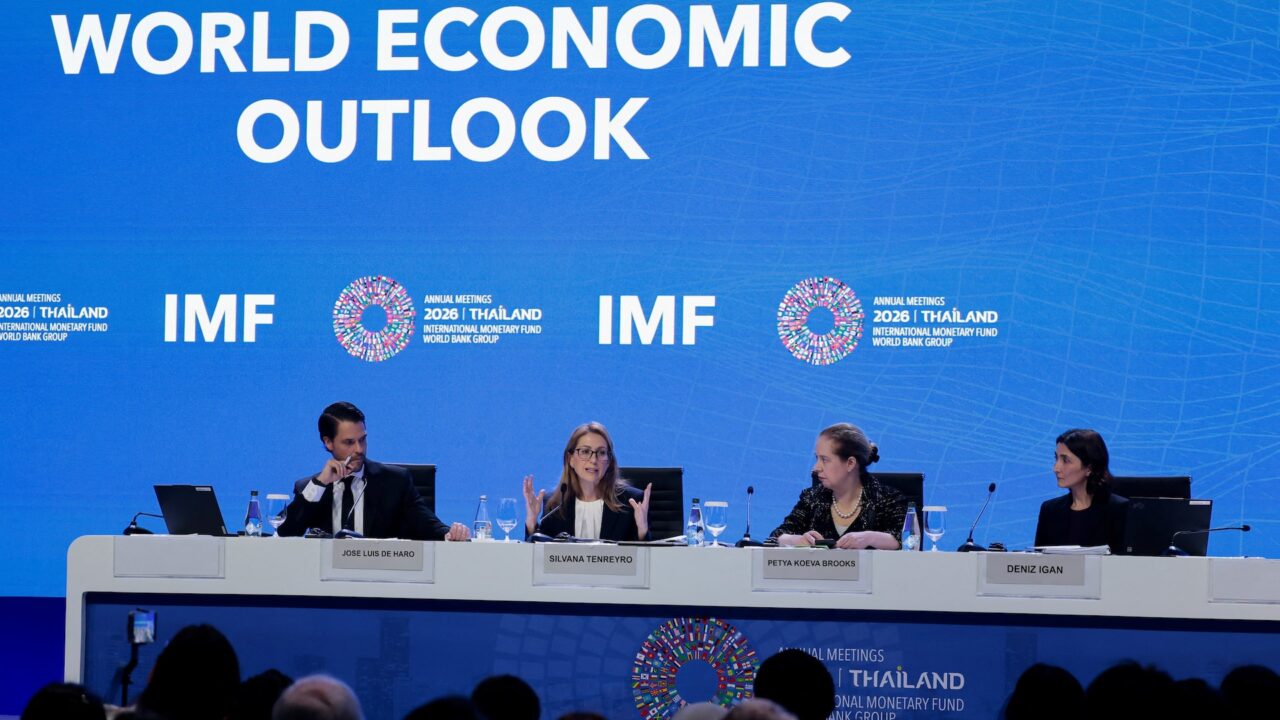
The International Monetary Fund (IMF) has warned that a slowdown in artificial intelligence (AI) investment could trigger a global market sell-off, as rising corporate debt, higher government bond yields and cyber threats increase risks to financial stability.
In its Global Financial Stability Report released on Tuesday, the Fund cautioned that growing investor optimism about AI could give way to a sharp correction if the technology delivers lower economic returns than expected.
While the report admitted that AI investment has helped sustain market confidence amid geopolitical tensions and economic uncertainty, the IMF however said that emerging evidence suggested that future AI capabilities might require less investment than anticipated, while the economic gains could fall short of expectations.
“An AI market correction will affect the real economy,” Athanasios Vamvakidis, deputy director in the IMF’s Monetary and Capital Markets Department, said at a press briefing in Bangkok.
He warned that strong market sentiment, underpinned by corporate earnings and enthusiasm for AI, should not be mistaken for financial safety.
The global lender said that a reversal in AI investment could reduce corporate spending, erode investor wealth and spread financial stress beyond the technology sector.
While expressing concern over what it described as ‘growing reliance’ on debt to finance AI infrastructure, including data centres, cloud computing and advanced chips, the IMF warned that excessive leverage could force companies and investors to sell assets during a downturn, amplifying market volatility.
The report noted that major cloud and technology infrastructure companies, known as hyperscalers, now account for 10 per cent of global investment-grade bond issuance, up from less than one per cent in 2024.
Consequently, the IMF urged policymakers to curb excessive borrowing, including through derivatives and margin loans, to limit the risk of an AI-related correction spreading across financial markets.
The Fund also warned that rising government bond yields and mounting public debt could compound the risks.
It also added that higher energy prices, persistent fiscal deficits and elevated sovereign debt levels have increased pressure on bond markets since its April assessment.
The report also stated that investors were concerned about whether markets could absorb the growing volume of government and corporate debt as central banks reduce their balance sheets, leaving borrowers increasingly dependent on price-sensitive investors.
It noted that higher yields could raise borrowing costs for governments and businesses, potentially constraining investment and worsening financial pressures.
As the IMF report stated, cybersecurity also presents another threat.
It further said that emerging markets were particularly vulnerable because of limited resources, while the concentration of critical services among a small number of technology providers increased the risk of widespread disruption.

In more than 70 per cent of cases recorded so far in 2026, the IMF report maintained that software providers had almost no time to patch vulnerabilities before they were exploited, a 20-percentage-point increase from a year earlier.
Although AI can strengthen cyber defences, it can also make attacks more sophisticated.
Thus, the IMF warned that a major attack on a financial institution or critical service could undermine confidence and disrupt markets.
Though the Fund said that banks’ capital buffers remained generally resilient under stress tests simulating an AI slowdown and fragile bond markets, it however said that banks accounting for 22 per cent of global banking assets showed weak capital levels under the scenario, compared with 18 per cent in the 2025 test.
While stressing that the risks could become systemic if market vulnerabilities magnified individual shocks, the IMF urged policymakers to strengthen financial oversight, improve cybersecurity and put public debt on a sustainable path.