
Vice President Kashim Shettima has said that the Federal Government would accelerate the development of a National Food and Nutrition Bill to protect nutrition financing, strengthen accountability and ensure continuity of interventions beyond successive administrations.
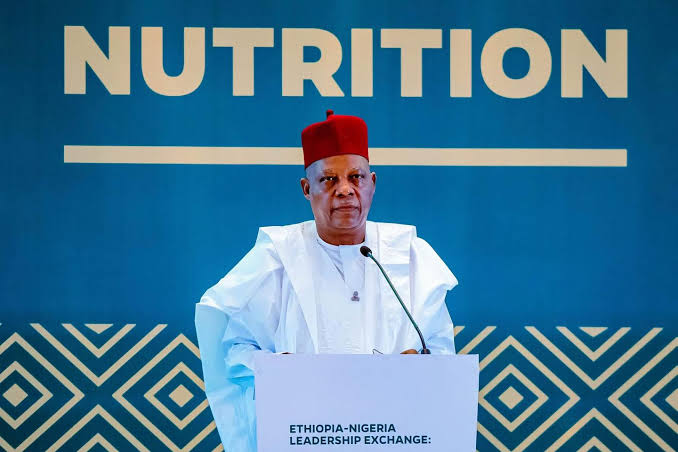
Shettima disclosed this on Wednesday at the Nigeria-Ethiopia Nutrition Leadership Exchange Forum in Addis Ababa, where he said that the proposed legislation would provide stronger backing for Nigeria’s nutrition response and deepen collaboration among the federal, state and local governments.
The Vice President, in a statement by his spokesman, Stanley Nkwocha, stated that the legislation would also strengthen the government’s Nutrition 774 Initiative, which brings all three tiers of government together to tackle malnutrition at the community level.
He maintained that the initiative was designed to make each local government the basic unit for planning, financing and accountability in the delivery of nutrition interventions.
“We are convinced that, with nutrition committees in 32 state assemblies, there is no better time for us to accelerate the development of a National Food and Nutrition Bill and the advancement of a federal, state and local compact to protect financing and enforce accountability beyond administrations,” Shettima said.
He disclosed that nutrition committees had also been established in more than 450 local governments, while the Federal Government was strengthening state councils and delivery capacity across all levels.
According to the Vice President, Nigeria’s National Policy on Food and Nutrition 2026-2035 targets a reduction in the country’s stunting rate from its current level to 32 per cent by 2029, 28 per cent by 2032 and 25 per cent by 2035.
He went further to say that the government’s $26m commitment to the Child Nutrition Fund had attracted a matching support, bringing the total to $52m, while 21 states had contributed $6.3m since 2023 towards supplies for the prevention and treatment of malnutrition.
He also announced plans for a Presidential Nutrition Investment Fund to provide catalytic financing, while the Nutrition Financing Subcommittee was working to mobilise additional domestic resources.
“We can only claim that our budget fulfils its purpose when it nourishes a child,” the Vice President said, stressing the need to link public expenditure to measurable nutrition outcomes through scorecards and stronger domestic financing.
Shettima said that the urgency of the intervention was underscored by the fact that about 40 per cent of Nigerian children under the age of five were affected by stunting, with undernutrition estimated to cost the economy $56bn annually. “We act to protect learning. We act to preserve earnings. We act to protect productivity,” he said.
While saying that the government was engaging food vendors, small and medium enterprises, manufacturers, financiers and regulators under its Private Sector Engagement Framework to improve the availability and affordability of nutritious food,
Shettima also added that the government was working with industry stakeholders and regulators to improve compliance with food fortification requirements covering salt, flour, edible oil and sugar. He said that Nigeria and Ethiopia would work towards a joint statement outlining continued cooperation on nutrition.
Earlier, Ethiopia’s Deputy Prime Minister, Temesgen Tiruneh, said that the longstanding relationship between both countries could help shape Africa’s development trajectory.
He said that Ethiopia had placed food and nutrition at the centre of its development agenda, stressing that sustained political leadership, financing and accountability were required at every level of government.

Tiruneh said that more than 100,000 Ethiopian children had been protected from malnutrition through community mobilisation and improvements in the nutritional value of food.
Also speaking, the Ethiopian Minister of Health, Dr Mekdes Daba, said that the leadership exchange focused on one of Africa’s most urgent development challenges which is child malnutrition, with particular attention to Ethiopia’s Seqota Declaration, the country’s commitment to end child stunting by 2030.
Daba said that nutrition during the first 1,000 days of life had far-reaching implications for health, education and economic productivity. She stated that Ethiopia’s experience demonstrated that malnutrition could not be tackled by a single ministry or sector, but required coordinated action across government and society.
The Nigerian delegation, which included governors and ministers, pledged to strengthen the country’s nutrition value chain through increased investment in technology, financing, education and food systems.
Meanwhile, Shettima and Tiruneh held a bilateral meeting on the sidelines of the forum, where they reviewed the relations between Nigeria and Ethiopia and explored opportunities for greater cooperation in trade, investment, food security, aviation and security.
While conveying Ethiopia’s condolences to Nigeria over the recent air crash in Ondo State, Tiruneh said that his country attached great importance to its relationship with Nigeria, particularly as both are among Africa’s most populous nations.
He said that Ethiopia’s decision to treat nutrition as an economic and development issue led to the launch of the 15-year Seqota Declaration in 2015, initially targeting communities worst affected by malnutrition before expanding it to about half of the country.
The Deputy Prime Minister, who commended the growing private-sector cooperation, including investments by the Dangote Group in Ethiopia, also welcomed progress on the Transfer of Sentenced Persons Agreement between the two countries, calling for the convening of the Nigeria-Ethiopia Joint Commission.
Responding, Shettima reaffirmed Nigeria’s commitment to deepening bilateral relations with Ethiopia, saying that both countries had a responsibility to leverage their populations, resources and strategic positions to advance Africa’s development.
While calling for a stronger intra-African investment under the African Continental Free Trade Area, Shettima commended Ethiopia’s progress in agriculture and domestic value addition. He also reaffirmed Nigeria’s commitment to the Joint Commission and called for expanded cooperation in investment, agriculture, economic development and security.
According to Shettima, Nigeria and Ethiopia, with their large populations and strategic positions on the continent, must provide the leadership needed to unlock Africa’s economic potential.