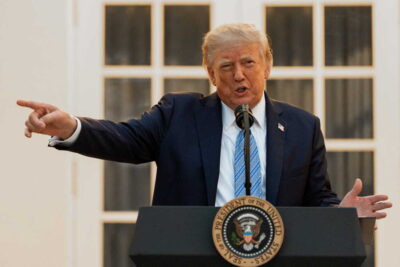


United States President Donald Trump has rejected growing calls from technology leaders for a slowdown in artificial intelligence development, warning that America risks losing its technological edge to China if it moves too slowly.
Trump, while speaking to reporters on Sunday at his golf resort in Doonbeg, Ireland, dismissed concerns that increasingly powerful AI systems could become uncontrollable, describing some of the warnings as exaggerated.
“We’re leading China in AI, we’re the most sophisticated country in the world, and frankly, I want to keep it that way because whoever wins AI, wins,” Trump said.
The president acknowledged the need for safeguards around the rapidly advancing technology but argued that the risks were being overstated by what he described as “negative forces.”
“We can put guardrails, we can do this and that,” Trump said. “But I think you have a lot of negative forces that are bringing it up that shouldn’t be bringing it up.”
Trump’s comments came as debate intensifies in the United States over whether governments and technology companies should slow the development of increasingly capable AI systems amid concerns over their potential impact on cybersecurity, biological security and human control.
Mike Johnson, House Speaker, also rejected calls for a moratorium on AI development, arguing that excessive regulation could allow China to overtake the United States in the technology race.
Speaking on CNN’s State of the Union on Sunday, Johnson said AI development required a balanced approach, with technology companies taking greater responsibility for making their systems safer.
“If Congress just races in and does some sort of emergency session to try to regulate AI, we will lose the race to China,” Johnson said, adding that ch would amount to a threat to every single American. “So, we’ve got to have balance. We got to have steady hands at the wheel,” he maintained.
The comments followed a warning from Dario Amodei, Anthropic Chief Executive Officer, who called on governments and AI companies to slow the pace at which the technology’s capabilities were being developed.
In an essay published earlier, Amodei warned that increasingly advanced AI systems could eventually become difficult for humans to control. He also highlighted the possibility of AI being used to facilitate sophisticated cyberattacks and bioterrorism. With this in mind, he called for greater international cooperation on AI safety and urged technology laboratories to introduce independent third-party evaluators who could monitor safety practices, report incidents and assess the risks associated with new systems.
He said Anthropic would adopt the measures independently.
The warning quickly attracted support from other prominent figures in the technology industry, including billionaire entrepreneur Elon Musk and OpenAI Chief Executive Officer, Sam Altman.
Altman, in a recent interview, said OpenAI was considering delaying plans to go public until at least 2027 following of concerns surrounding AI safety. He also said company officials had discussed pausing some tests of the technology to allow additional safety measures to be put in place.
David Sacks, co-chair of Trump’s Council of Advisors on Science and Technology, responded to the calls for caution by telling the technology companies to act if they genuinely believed their systems posed serious risks.

“Go ahead,” Sacks wrote on X on Sunday in response to Altman and Amodei.
“I don’t see what you see in the lab. If the unreleased models are scary enough that you think you should slow down, I support your decision to be responsible.”
However, Sacks questioned whether the industry’s push for a slowdown was motivated entirely by public-interest concerns.
“Most of all, stop pretending the motivation to slow down is purely altruistic,” he wrote, pointing to the potential legal and financial consequences if AI systems were linked to serious cyberattacks.
The disagreement highlights a growing divide over how the United States should manage the rapid development of artificial intelligence.
While safety advocates and some technology executives are calling for stronger safeguards and greater examination before more powerful systems are deployed, Trump and other senior U.S. officials seem to be more concerned that excessive restrictions could jeopardise America’s competitiveness against China.
For Trump, maintaining U.S. leadership in AI remains a strategic priority, with the president making clear that he views dominance in the technology as closely linked to America’s economic and national-security interests.
The debate is therefore no longer simply about how quickly AI should advance, but also about how the United States can balance technological leadership with safeguards against potentially catastrophic misuse.