

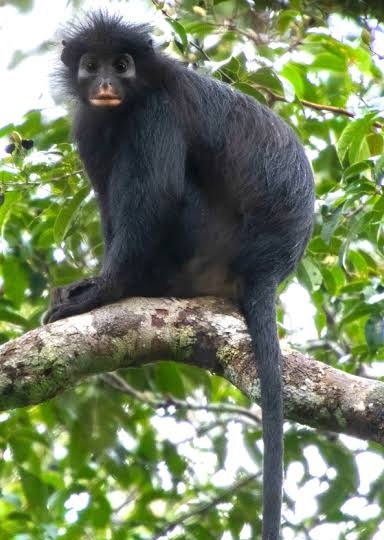
Scientists have identified a new species of monkey with distinctive orange lips and a deep roaring call in the Democratic Republic of Congo.
The newly identified primate, Colobus congoensis, locally known as Likweli, is only the fifth new monkey species discovered in Africa in the past 75 years, according to a study published in the journal PLOS ONE.
Researchers from Florida Atlantic University and the City University of New York (CUNY) Graduate Center said the monkey has a glossy black coat, long silky fur, a sweeping tail, and striking orange-cream facial markings. They added that its unique cranial, dental, and skeletal features clearly distinguish it from all other known African colobus monkeys.
The species is also smaller than its close relatives, weighing about 6.8 kilograms (15 pounds), and is recognised by its sleek, light-reflecting fur, large folded ears, and long black facial hairs that accentuate its dramatic facial appearance.
According to Kate Detwiler, an associate professor of biological sciences at Florida Atlantic University, the discovery is reshaping scientists’ understanding of African monkey evolution.
Genetic analysis revealed that its closest known relative is Colobus satanas, found more than 1,200 kilometres away in west-central Africa. Despite the distance, the two species are believed to have diverged between 4 and 5 million years ago, representing one of the oldest evolutionary splits within the Colobus lineage.
The journey to formally identify the species began in 2008, when researchers first photographed an unusual monkey in east-central DR Congo. A clearer observation followed a decade later, and scientists recorded 114 sightings between 2018 and 2022.
Beyond field observations, the research team examined the monkey’s genetics and incorporated local ecological knowledge to confirm that it represented a previously undescribed species.
Co-author Christopher Gilbert, a professor of anthropology at the CUNY Graduate Center and Hunter College, said the team compared skulls, pelts, skeletal anatomy, and museum specimens of all known African colobus monkeys before concluding that Colobus congoensis is a distinct species.
Researchers have also raised conservation concerns, noting that the monkey has only been observed across a range of about 1,700 square kilometres.
They recommend that the species be classified as Endangered due to its limited distribution, habitat destruction, and hunting pressure.
Most of the monkey’s known habitat lies within Lomami National Park, making continued protection of the rainforest essential for its survival.
Commenting on the discovery, Alexander Georgiev, a primatologist at Bangor University in Wales who was not involved in the study, described the research as thorough and convincing. He noted that discovering a completely new monkey species that is largely unknown even to nearby communities is exceptionally rare.
Georgiev added that residents in only eight of the 52 villages surrounding the species’ range were familiar with the primate, highlighting how the vast and largely unexplored Congolese rainforest has allowed the species to remain hidden from science for so long.


