

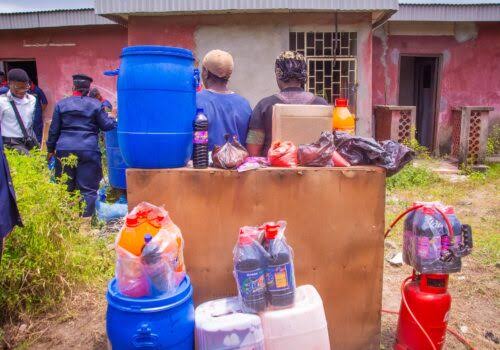
The Nigeria Security and Civil Defence Corps (NSCDC) has arrested two women for allegedly operating an illegal juice factory in Aradagun, in the Badagry area of Lagos State.
The factory, where a drink branded Barkas Juice was allegedly produced, was uncovered by NSCDC operatives at Talabi Onilegbale Street, Aradagun, Olorunda Local Council Development Area, on September 19, 2026, at about 9:00 p.m.
The two women, aged 48 and 50, were arrested at the premises by operatives of the NSCDC Badagry Divisional Headquarters.
The corps alleged that the factory was unregistered and that the product, made under Titi Alubarika Trading Stores Ltd, carried a purportedly fake National Agency for Food and Drug Administration and Control (NAFDAC) registration number, 01-2166L.
When our correspondent visited the premises, a truck loaded with the products was still at the factory, apparently awaiting distribution.
Cartons of the drink and rolls of product labels were also seen inside the bungalow being used for production, while part of the building served as a residence.
A dirty well, which the NSCDC said was being used to source water for production, was also seen within the premises, alongside an unclean industrial storage tank.
The operation, according to the NSCDC, followed five days of surveillance after intelligence was received about the activities at the location.
The corps also alleged that the products were being distributed to Edo State and other parts of the country.
Reacting to the incident, the Lagos State NSCDC Commandant, Adedotun Keshinro, said the operation was conducted after operatives encountered resistance from youths in the area.
Keshinro, who spoke through the NSCDC spokesperson, Oluwaseun Abolurin, said the corps had to strengthen its inter-agency collaboration, including involving the Nigerian Army, to guard against possible attacks.
He, however, noted that community support helped the operation to succeed.
He said: “Adulterated fruit drinks are being produced in this factory and supplied to Edo State and other parts of the country. The products were found packed in cartons and also loaded in a truck.”
Keshinro described the alleged production process as a threat to public health, urging Nigerians to be wary of unregistered fruit drinks.
He added that the NSCDC contacted NAFDAC to verify the registration details on the product and was informed that the product was not registered.

The commandant further alleged that the drink contained high levels of sugar, additives and dyes, but did not provide laboratory findings to substantiate the claim.
Speaking to our correspondent, the primary suspect, Morenikeji Alawiye, said the factory had originally been established by her grandmother and had been operating for nearly two decades, although she acknowledged that it had previously been shut down.
According to her, the family initially produced bottled and sachet water before the factory ran into difficulties.
Alawiye said she had been trying to regularise the business before her arrest and claimed that she had contacted an uncle working with NAFDAC to assist with the process.
She also said an aunt had introduced a prospective customer in The Gambia who wanted the product manufactured for export.