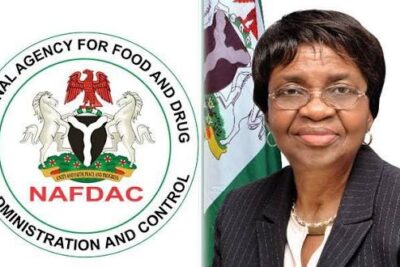


The Director-General of the National Agency for Food and Drug Administration and Control (NAFDAC), Prof. Mojisola Adeyeye, has said the agency is not in existence to frustrate small businesses but to protect Nigerian consumers and encourage honest manufacturers to produce safe, wholesome and quality products.
Prof. Adeyeye gave the assurance at the SMEDAN–NAFDAC Summit held recently in Lagos, where she acknowledged that many MSME operators associate the name “NAFDAC” with fees, delays and cumbersome documentation.
According to a statement by the agency’s Resident Media Consultant, Sayo Akintola, she assured participants that NAFDAC would continue to partner with MSMEs as major employers of labour who drive the Nigerian economy.
For many entrepreneurs, she noted, the journey from a promising idea in the kitchen, on the farm or in a small factory to a registered, trusted and exportable product is the most important journey of all.
At NAFDAC, she added, “our task is to make that journey short, affordable and predictable with outcomes that are safe.”
Prof. Adeyeye emphasised that a NAFDAC registration number is more than a number on a label, describing it as a mark of trust that assures consumers in Kano, Aba and Abuja, as well as buyers in Accra, London and Johannesburg, that a product has been evaluated and its manufacturer operates within a system of quality and safety.
“That trust is the most valuable asset any small business can own.”
According to her, this is why the agency has repositioned itself as an enabler of industry, while remaining firm in its regulatory commitment to quality, safety and efficacy.
She explained that NAFDAC was established by Decree No. 15 of 1993, amended by Decree No. 19 of 1999, and now operates under the National Agency for Food and Drug Administration and Control Act, Cap. N1, Laws of the Federation of Nigeria, 2004. The Act mandates the Agency to regulate and control the manufacture, importation, exportation, distribution, advertisement, sale and use of food, drugs, cosmetics, chemicals, detergents, medical devices and packaged water, collectively referred to as regulated products.
Prof. Adeyeye noted that NAFDAC is ISO 9001:2015-certified and has attained Maturity Level 3 under the World Health Organization’s Global Benchmarking framework for regulatory authorities, with Maturity Level 4 in view. She stressed that registration and licensing are among the Agency’s regulatory mechanisms for ensuring that regulated products meet applicable standards of safety, quality and efficacy.
During the interactive session with MSME operators, the Director-General outlined the basic steps involved in product registration.
Speaking on NAFDAC’s interventions to support MSMEs, Prof. Adeyeye acknowledged that cost, time and procedural complexity can pose barriers to formalisation.
She explained that the agency had deliberately introduced measures over the years to reduce these barriers and encourage small businesses.
The NAFDAC Director-General cautioned business owners against relying on consultants or agents to facilitate product registration.
She explained that many applications are delayed because of incomplete documentation, inadequate labelling or facilities that are not ready for inspection.

“A conversation with us before submission saves time and money,” she said.
She expressed concern that some entrepreneurs reported paying several million naira to agents not recognised by NAFDAC for services that would have attracted much lower official charges.
Prof. Adeyeye emphasised that MSMEs must be willing to meet the Agency halfway to benefit fully from these support measures. She explained that registration timelines are shortest when applications are complete, facilities are ready for inspection, applicants respond promptly to compliance directives and samples meet the required standards.
Turning to export opportunities, the Director-General noted that Nigeria has remarkable products, including processed foods, spices, cocoa and cashew derivatives, shea products, herbal and traditional preparations, and cosmetics. With the African Continental Free Trade Area (AfCFTA) bringing together a market of more than one billion people, she said the opportunity for Nigerian MSMEs had never been greater.
She, however, warned that opportunity without compliance leads to rejection, saying too many consignments from Nigeria had been turned back at foreign ports because of contamination, poor packaging or the absence of appropriate registration and certification.
She expressed dismay that every rejection costs exporters money, damages Nigeria’s reputation and creates obstacles for other exporters.
“Our shared target must be zero rejection of Nigerian exports.”
Prof. Adeyeye regretted that some exporters still bypass regulatory procedures or ship products without the required laboratory testing. She added that some product labels fail to meet destination-market requirements, while some manufacturers wait until their registrations expire before applying for renewal.
Prof. Adeyeye noted that the future of Nigeria’s economy would depend largely on how successfully MSMEs grow, formalise their operations and compete. She added that a safe, properly registered and quality product has the potential to move from the smallest market stall in Nigeria to retail shelves around the world.
“Compliance is not the end of the entrepreneurial journey; it is the passport that allows a product made in Nigeria to be trusted at home and respected abroad.”
She reaffirmed NAFDAC’s commitment to supporting every MSME on this journey, adding:
“Our doors are open, our officers are ready to guide you, and our shared goal is safe products, thriving businesses and a stronger Nigeria.”