

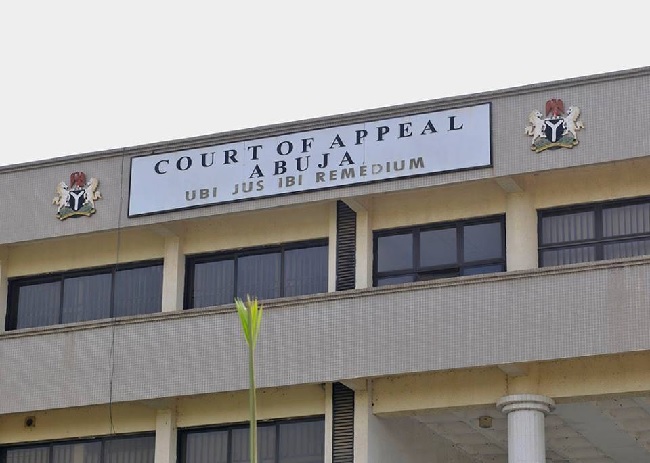
The Court of Appeal sitting in Abuja, on Thursday, vacated the judgment that nullified the timelines issued by the Independent National Electoral Commission (INEC) for the 2027 general elections.
The appellate court, in a unanimous decision by a three-member panel, upheld as meritorious, an appeal the electoral body filed to challenge the judgment delivered by the Federal High Court on May 20.
It held that the trial court failed to follow binding precedents, declaring that the Revised Timetable issued by INEC for the general elections is legally considered subsidiary legislation to the 2026 Electoral Act.
The appellate court held that such subsidiary legislation has the same force of law as the Electoral Act, adding that the INEC acted within its statutory powers.
The appellate court maintained that every deadline in the Revised Timetable for the 2027 general elections fell within the ambit of the Electoral Act.
INEC had in its notice of appeal dated May 25, raised nine grounds it urged the appellate court to consider and vacate the high court judgment.
Aside from its contention that the high court erred in law when it failed to determine a jurisdictional issue it raised, INEC maintained that the legal action the Youth Party (YP) initiated against it was not only hypothetical but academic.
It argued that failure of the trial court to make pronouncements on the issues resulted in the denial of fair hearing to the appellant.
INEC argued that the verdict of the trial court was against the weight of evidence that was placed before it by the parties.
The commission prayed the appellate court for an order allowing the appeal and setting aside the judgment.
The electoral body further urged the Court of Appeal to strike out YP’s case on the ground that it lacked the locus standi (legal right) to institute and maintain the action it said was merely academic.
It will be recalled that the high court had, in the judgment delivered by Justice Mohammed Umar, invalidated the timeline the INEC issued for the conduct of primaries and the nomination of candidates.
The court also set aside INEC’s May 10 deadline requiring political parties to submit a register and database of all their members as a condition for qualifying to participate in the general elections.
It held that the time frame the Commission imposed for political parties to conduct their primaries and to submit, withdraw, or replace the names and particulars of their candidates for the general elections “is inconsistent with the provisions of the Electoral Act, 2026.”
The judgment followed YP’s suit to compel the electoral body to comply with the Electoral Act 2026’s 120-day pre-election deadline for submitting party registers and candidates’ personal particulars.

INEC was listed as the sole defendant in YP’s suit marked: FHC/ABJ/CS/517/2016.