
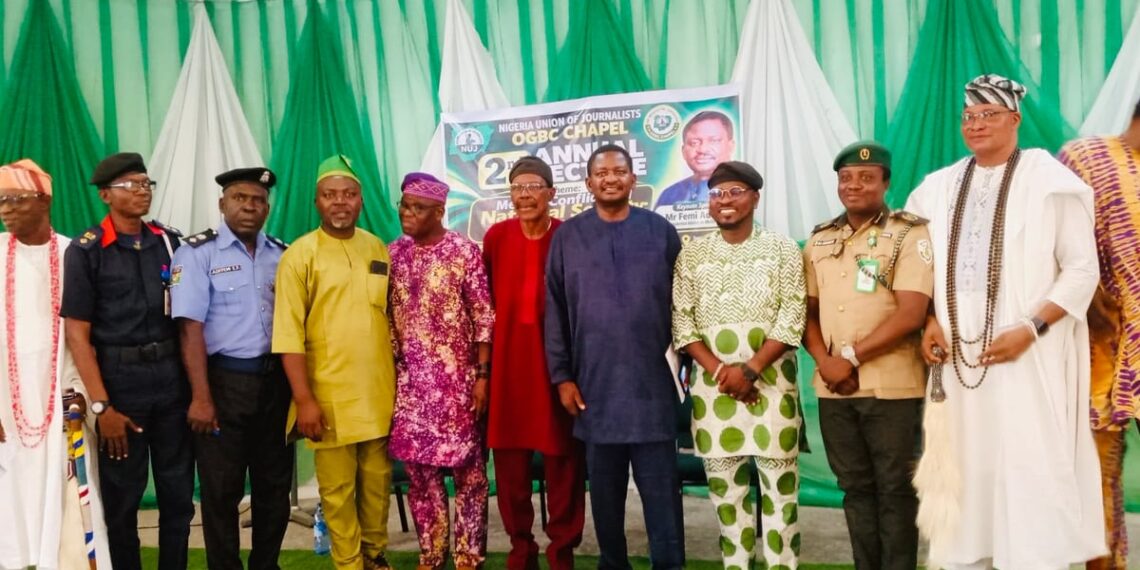
Former presidential spokesman, Femi Adesina, has urged Nigerian journalists and media organisations to stop giving terrorists free publicity and instead amplify the sacrifices, courage and achievements of security personnel in the fight against insecurity.
He made the call on Thursday in Abeokuta while delivering a paper titled, “Media, Conflict and National Security: The Journalist’s Role in a Changing Security Landscape,” at the second annual lecture of the Nigeria Union of Journalists (NUJ), Ogun State Broadcasting Corporation (OGBC) Chapel.
Adesina, who served as the Special Adviser on Media and Publicity to the late President Muhammadu Buhari, said the media wielded enormous power capable of building or breaking a nation.
He noted that journalists must recognise the consequences of their reportage, particularly in a country battling terrorism, banditry and other security threats.
Citing the 1994 Rwandan genocide, Adesina recalled how two radio stations played significant roles in fuelling ethnic hatred, violence and disinformation that contributed to the massacre of hundreds of thousands of people.
He noted that several broadcasters involved in the propaganda were subsequently convicted for genocide and war crimes, questioning the value of justice that could not restore the lives lost.
“But what kind of justice can bring back the hundreds of thousands of souls who were killed?” he asked.
Adesina contrasted the Rwandan experience with the contribution of Radio Kudirat to Nigeria’s pro-democracy struggle, as well as Hollywood’s role in promoting America’s global image.
According to him, the examples demonstrate the enormous influence of mass communication platforms and the responsibility that comes with controlling them.
He expressed concern that sections of the Nigerian media give considerable attention to individuals promoting violence, ethnic divisions and religious intolerance, while constructive voices and perspectives are often ignored or underreported.
Adesina, however, clarified that his appeal was not for journalists to become government propagandists but to embrace truthful, realistic and balanced reporting, with greater attention to positive developments.
He questioned why the activities of Boko Haram and other terrorist groups frequently dominate media coverage, while the sacrifices and operational successes of officers and men of the Nigerian Armed Forces receive comparatively less attention.
Quoting former British Prime Minister Margaret Thatcher’s warning against giving terrorists the “oxygen of publicity,” he maintained that media organisations should avoid becoming platforms for promoting the activities and propaganda of criminal groups.
“There is no justification for media houses and professionals of mass communication acting as spokespersons and loudspeakers for terrorists. If there is anything to be amplified, it must be the heroism of our law enforcement agents,” Adesina added.
The former presidential spokesman also cautioned journalists against sensational and misleading headlines designed to generate clicks, likes and retweets at the expense of accuracy and responsible reporting.

He urged media practitioners to return to established principles of ethical journalism, particularly the distinction between facts and opinions.
“We must refrain from ‘clickbait’ headlines, designed only to mislead and inflame and misdirect, all for the sake of likes and retweets. We must re-embrace the tested and tried principles of ethical journalism: opinions are free but facts must always remain sacred,” he said.
Adesina further argued that while the media must continue to hold government accountable, its watchdog responsibility should ultimately contribute to building stronger institutions and a better society rather than promoting national disintegration.
Earlier, the Chairman of the NUJ OGBC Chapel, Comrade Chris Ogbu, said Nigeria was confronted with complex security challenges requiring responsible media engagement.
He described the media as a critical institution in shaping public understanding, strengthening democratic governance and influencing national responses to security concerns.
Ogbu urged journalists to uphold the highest standards of professionalism, accuracy, fairness and ethical conduct, particularly when reporting issues relating to national security.
He stressed that the influence of the media extended beyond reporting events, placing an enormous responsibility on practitioners to ensure that their work served the public interest.
Also speaking, the Chairman of the NUJ Ogun State Council, Comrade Wale Olarenwaju, who was represented by the council’s Secretary, Comrade Bunmi Adigun, described the theme of the lecture as timely and relevant, given Nigeria’s prevailing security challenges.
He maintained that journalists were not merely reporters of events but important stakeholders in nation-building.
The union leader urged media practitioners to look beyond breaking news and attracting public attention by ensuring that their reportage promoted responsible public discourse, national development and democratic accountability.